
UCSB capstone / XR
Online VR Diagnostic Platform
A therapist and a patient in the same virtual room.
A capstone with WellHealth that moved exposure therapy into VR, pairing an environment that adapts to the patient with a live console for the clinician.
What it does
A VR environment that adapts
A Unity scene places the patient in the situation they find stressful, and turns the intensity up or down as the session goes.
A live therapist console
A web client shows the clinician what the patient sees, alongside the session's transcript and signals, and lets them take the controls at any point.
A real-time feedback loop
Speech from the session is transcribed and analysed, and the result moves the environment's parameters — crowd size, ambient volume, conversation intensity.
Post-session analytics
The session is compiled into graphs and a simplified score, so patient and therapist can see progress between appointments rather than guess at it.
Therapy moved online, and left the room behind
When therapy went remote, it kept the conversation and lost the setting. A video call is a patient sitting at home, in the middle of their own life, talking about it. Exposure therapy in particular depends on the setting: the whole method is controlled contact with the thing the patient finds difficult, and a laptop screen cannot supply it.
The capstone team — five of us, working as SegFault with WellHealth, a patient communication company based in Santa Barbara — took that as the problem worth solving. The result was VCare: put the patient in a virtual environment that can actually be uncomfortable on purpose, and give the therapist a console that shows what is happening and lets them steer it.
What VCare does
The patient puts on a headset and lands in an environment built to hold the source of their anxiety — a social setting, with people in it, ambient noise, conversation. The therapist is in the session too, on the web client, seeing what the patient sees.
What makes it a therapeutic tool rather than a scene is that the environment moves. Crowd size, the volume of the room, the intensity of the conversation: each is a parameter, adjustable during the session. A feedback loop reads the session as it runs — speech is transcribed and run through tone and language analysis — and eases those parameters up as the patient settles, so the difficulty follows the patient's own pace instead of a script. The therapist can override any of it from the console, or take manual control entirely.
Afterwards, the session becomes data: graphs over time and a simplified score, so progress is something the patient and the clinician can both look at rather than recall.
What I worked on
I was on the VR side — the Unity environment and the wiring that kept it in step with the therapist's console. Most of the interesting work was in that seam. The headset and the web client have to agree on what the session currently is, and they are not in the same process, not on the same machine, and not even on the same kind of device. Get it wrong and the therapist turns the room down while the patient is still standing in a crowded one.
The other thing I remember is how much of the difficulty was not technical. Deciding when the environment should push harder is a judgement call, and we kept having to hand that judgement back to the therapist instead of letting the algorithm quietly make it.
Recognition
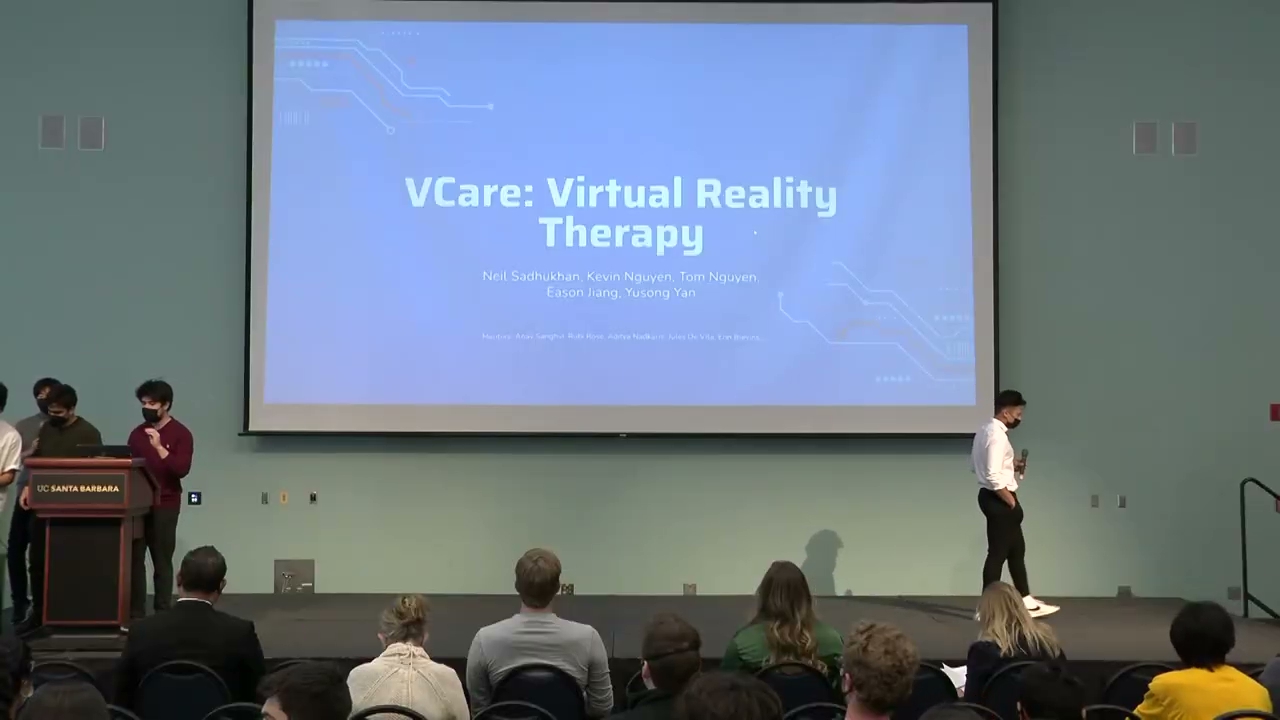
VCare took second place at the UCSB Capstone 2022 showcase, out of the year's project cohort. The team was Neil Sadhukhan (lead), Kevin Nguyen (scribe), Tom Nguyen, Yusong Yan and me, with mentors from WellHealth and from the UCSB faculty.
Technology
- Experience
- Unity XR
- Services
- Python · Django
- Cloud & data
- AWS · MongoDB
Resources & further reading
Select a document to read it here, without leaving the page.
- Capstone document · Fall 2021
Vision statement
The team's first brief with WellHealth, before the pivot — a no-show prediction tool for medical office assistants. Useful as the "before" picture.
- Capstone document · PRD
Requirements, v1
Where VCare starts: the problem, the three core components, user stories for both the patient and the therapist, and the assumptions behind them.
- Capstone document · PRD
Requirements, v2
The revised requirements after a quarter of building, with the system architecture diagram and the technology appendix.
- Capstone document · CS189A
First-quarter presentation
The end-of-CS189A review: what existed at the halfway point and what was still a plan.
- Capstone document · Sprints 5–8
Development plan
The second-quarter plan, sprint by sprint — video into the web app, biometrics, the automatic level adjustment, post-session analysis.
- Capstone document · CS189B
Final presentation
The closing deck — motivation, the three pieces of VCare, the live demo, and where the team would have taken it next.
- Capstone document · Showcase
Final poster
One page: motivation, solution, architecture, and what happens after a session.
- Technical notes · Markdown
Architecture & product notes
A short reference to the product flow, system boundaries, and implementation choices.